
Banks. Flights. Food. Media.
In the first half of November, it felt like everything broke at once. Outlook went down. Every flight in the US was grounded. Online banking stalled. Supermarket freezers across Europe warmed up, and some of the world’s biggest websites served malicious code to their visitors.
Social media quickly joined the dots and called it a coordinated cyberattack. We checked every incident against what the organisations, regulators and security researchers actually said. The real picture is less dramatic, and far more useful for any business that relies on IT.
What actually happened.
- Nov 02European supermarket freezers hackedCyberattack
Hackers remotely raised the temperature of refrigeration systems in supermarkets across at least 11 European countries, including the UK, forcing stores to throw away food. Pro-Russian groups claimed responsibility. Al Jazeera
- Nov 12Microsoft 365 goes downNot an attack
Outlook, Teams, Copilot and Exchange Online were disrupted for more than a day. The cause was a latent software defect in Microsoft’s networking gateway servers. Business Standard
- Nov 13FAA grounds every US departureNot an attack
A communications failure at air traffic control centres led to the first nationwide ground stop since 2023. Around 12,460 flights were cancelled. Officials pointed to network data flooding and, reportedly, a faulty router. FAA
- Nov 16US online banking disruptedNot an attack
Chase customers struggled to log in, check balances and move money, and complaints spread to other banks. Chase said the cause was a technical problem, not a cyberattack. AP via OPB
- Nov 16United Airlines halts departuresNo sign of attack
A “widespread system outage” held United’s departing flights. The airline said there was no indication of a cybersecurity issue. AP via OPB
- Nov 16Australian supermarket Coles investigatesInvestigating
Coles confirmed a cyber security incident. Early findings showed no customer, staff or supplier data had been taken, and stores kept trading. Insurance Business
- Nov 16BBC, CNN & Fox News sites serve malicious codeAttack · via supplier
Researchers found card-skimming code in files from Optimizely, a website tool used by around 178 organisations. The sites’ own servers weren’t necessarily breached: the code came in through a trusted supplier. Malwarebytes
Most of it wasn’t hackers.
Four of the seven incidents were plain technical failures: a software bug, overloaded network equipment, a faulty router and a system outage. Nobody broke in. They happened to some of the best-resourced organisations in the world.
Of the three real attacks, two didn’t come through the front door at all. One came through remotely connected equipment (supermarket refrigeration controls), and one came through a trusted third-party tool running on hundreds of websites.
For most firms, the bigger risk isn’t a hacker targeting you personally. It’s a supplier, an ageing bit of kit, or a cloud service going down with no plan for what happens next.
Four things to check this month.
- Know your suppliersList the third-party tools on your website and the companies with remote access to your systems and equipment. Each one is a door into your business.
- Look after the boring kitRouters, switches and firewalls fail too. Keep them monitored, updated and replaced before they reach end of life.
- Plan for “when email stops”Keep key client contacts and deadlines somewhere other than your inbox, agree a backup way to communicate, and decide who makes the call.
- Test your backups, safelyRestore something real at least a few times a year, with someone who knows how to do it without causing an outage of your own.
In short.
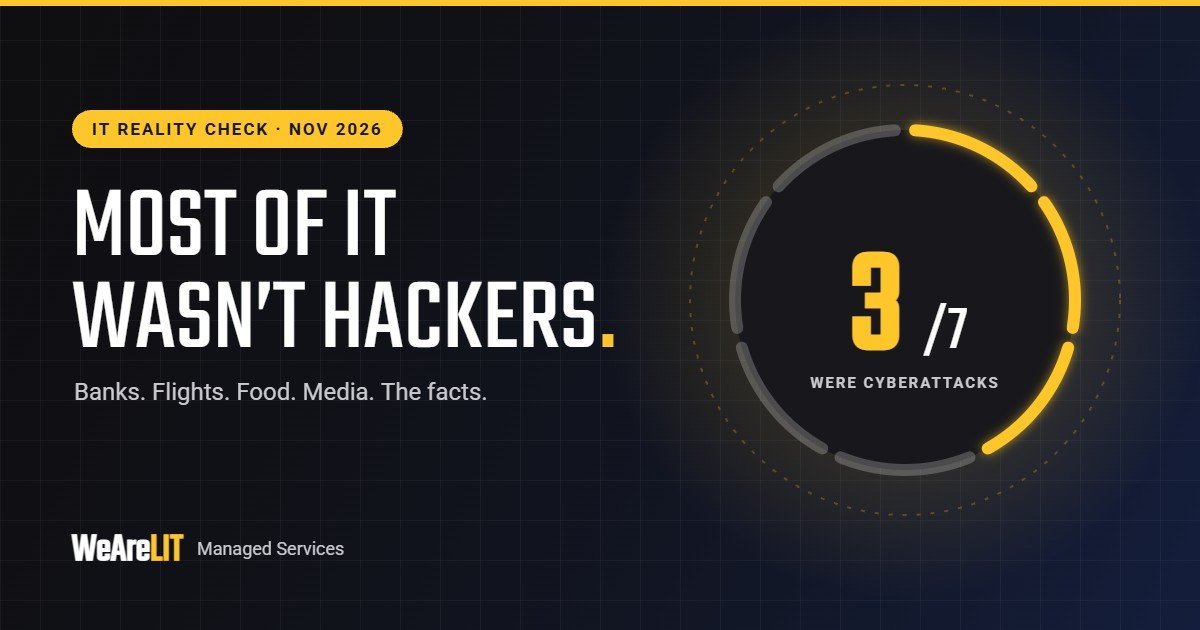
- 7 major incidents in two weeks, but only 3 were cyberattacks
- Technical failures caused most of the disruption
- The real attacks came in through connected kit and suppliers
- A tested plan beats panic every time
Sources
- EU urges action as Germany, Romania and UK report supermarket cyberattacks, Al Jazeera (4 Nov 2026)
- Pro-Russian hackers claim attack on supermarket refrigerators, RetailDetail (5 Nov 2026)
- Cyberattacks, tech outages in 2026: full list, Business Standard
- November 2026 technology outages, Wikipedia
- Nationwide ground stop: questions and answers, FAA (15 Nov 2026)
- FAA explains cause of nationwide ground stop, General Aviation News
- A technical issue at JPMorgan Chase triggers online banking delays, AP
- United Airlines says it has a widespread system outage, AP
- Coles investigates cyber security incident, no data loss found, Insurance Business
- CNN, BBC, Zoom and other sites served malicious code, Malwarebytes
Want to know where you stand?
Our free IT & Security Health Check shows you exactly where the gaps are, in plain English, with no obligation. Or book a free 30-minute call with John or Ramez and we’ll talk it through.